
- August 19, 2026
- Posted by: Shane Daly
- Category: Trading Article

You set a stop for a reason. So exiting before it’s hit feels like breaking your own rules. Sometimes it is. But sometimes the trade stops behaving the way your setup requires, and waiting for the stop just costs you more. The difference between the two isn’t a feeling — it’s measurable. And most traders never define it, which is exactly where the trouble starts.
Key Points
- Exit early only when the setup shows predefined evidence of invalidation—not because the unrealized loss feels uncomfortable.
- Define what the setup should do after entry so you can distinguish normal price movement from failed follow-through.
- Treat slow progress, minor pullbacks, and other weaker signals as warnings, not automatic reasons to tighten the stop or exit.
- Judge post-entry movement by setup behavior and market structure first; use ATR, volatility, and session context only as supporting evidence.
- Define and test early-exit rules before using them. A rule that reduces individual losses can still hurt expectancy if it removes too many eventual winners.
Should You Exit Before Your Stop Is Hit?
Why would you close a position while your stop still sits untouched? Because your stop defines maximum risk, not the moment your reasoning breaks down. Those are separate questions.
Your stop marks the price where the technical premise is definitively wrong. An early exit answers something different: has the setup stopped doing what you expected it to do? A breakout that snaps back into its range hasn’t hit your stop, but it’s no longer the trade you entered.
Protective Stop vs. Early-Exit Condition
Both should be defined before entry, but they answer different questions about the trade.
| Protective Stop | Early-Exit Condition |
|---|---|
| Defines maximum price-based risk | Responds to predefined deterioration |
| Usually tied to structure or risk | Usually tied to setup behavior |
| Triggered at a predefined price level | Can trigger before the stop is reached |
The danger runs both ways. Exiting because red numbers make you uncomfortable is emotional decision making dressed up as discipline. Ignoring clear deterioration because your stop’s still intact is equally careless.
Sound risk management means knowing which one you’re doing — reacting to evidence, or reacting to discomfort.
What Should Price Do After Entry?
Before you can call a trade deteriorating, you need a clear picture of what normal looks like for that specific setup. A breakout should break, hold above the range, and expand. A support bounce should produce upward progress from the level, not repeated failed attempts. A reversal should show a genuine change in behavior, not a pause in the prior trend.
Write your post entry expectations down before you enter. Define the sequence you’re paying for, the pace it should unfold at, and the movement size that fits current volatility. Without that reference, you’ll read every pullback as failure.
Trade dynamics then become measurable. You compare what price is doing against what the premise requires, and you classify the difference as normal, a warning, or invalidation.
What Price Movement Is Still Normal?
Normal movement should be judged first by the structure and behavior of the setup.
A breakout may retest the level it cleared. A pullback trade may move deeper into the setup area before resuming. Consolidation may also be normal if the original structure remains intact.
Volatility provides additional context. ATR can help show whether a move is large or small relative to recent price movement, but it does not determine whether the trade thesis remains valid.
What to Check Before Calling a Trade Weak
Adverse movement is not automatically deterioration. Check the setup and structure first, then use historical behavior and volatility as supporting context.
| Review Factor | What to Ask |
|---|---|
| Market Structure | Is the structure supporting the original trade still intact? |
| Setup Behavior | Is price still behaving within the normal range of this setup? |
| Historical Tendencies | Are the pullback depth and consolidation time typical of successful trades? |
| Volatility Context | Is the movement unusual for current volatility, or is it normal price noise? |
For example, a $0.60 pullback may be significant in a quiet market and routine in a more volatile one. The more important question is whether price is still behaving within the structure and conditions the setup allows.
Historical trade data can provide an even stronger reference. How deep were normal pullbacks in successful trades? How long did consolidation typically last before continuation? Those observations help distinguish normal variation from genuine deterioration.
What Is Failed Follow-Through in Trading?
Beyond ordinary friction sits a different problem: the setup stops doing what it’s supposed to do. A breakout should produce break, acceptance, then expansion. When price breaks out, gets rejected, and slides back into the range, you’re looking at breakout failure — the sequence your entry depended on never happened.
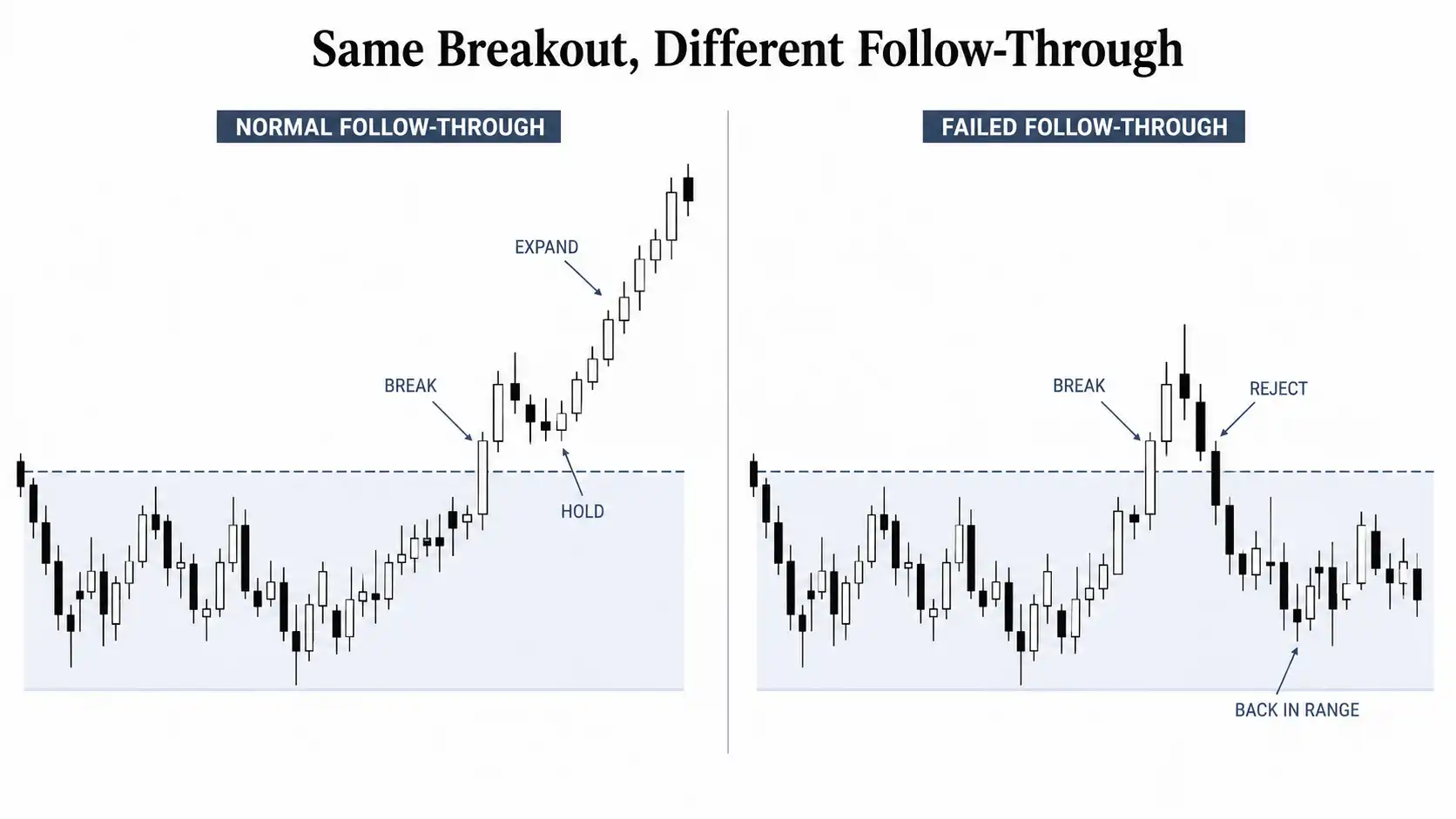
That’s failed follow through. The distinction matters: the trade didn’t just stop moving your way, the behavior you needed didn’t show up. Adverse movement alone tells you little. Missing behavior tells you plenty.
Because it’s setup-specific, define the expected sequence before you enter. A momentum trade needs expansion. A reversal needs a shift in character. A support bounce needs upward progress.
When that required step fails, your premise weakens regardless of where your stop sits.
When Is the Trade Thesis Invalidated?
How do you tell a trade that’s merely struggling from one that’s finished? You check it against three specific tests rather than your comfort level.
Price invalidation is the clearest: price reaches the level that contradicts your premise, breaking the trade structure you entered on — a lost support, a violated swing point.
Three Ways a Trade Thesis Can Fail
A trade can become invalid through price, behavior, or time. Each answers a different question about whether the original setup still justifies remaining in the position.
| Invalidation Type | What Fails | Example |
|---|---|---|
| Price | Price reaches the predefined structural or risk level. | Support breaks or a key swing point is violated. |
| Behavioral | The setup stops producing the behavior required by the premise. | A breakout fails and becomes accepted back inside the prior range. |
| Time | The expected move fails to occur within the setup’s normal window. | A momentum setup stalls well beyond its historically typical follow-through period. |
Behavioral invalidation is subtler. Your setup stops producing what it promised. A breakout that slips back inside its range isn’t just weak; it’s no longer a breakout.
Time invalidation applies when expansion never arrives within the window your setup typically needs.
Movement that does not meet an invalidation condition may be normal or may constitute a warning, depending on the setup.
When Does Time Become a Reason to Exit?
Some setups carry an expiration date, whether you’ve written one down or not. A momentum trade depends on quick expansion. A breakout depends on acceptance followed by movement.
If the strategy depends on timely follow-through, exceeding a predefined or historically supported time window can invalidate the original setup.
Time signals deterioration differently than price does. Nothing dramatic happens. The trade simply stops developing, and your capital stays tied up in a position that’s lost its edge.
Build the threshold from your own data. Review how long your winning trades usually take to move, then treat meaningful excess as a signal, not a hunch. Arbitrary bar counts won’t help.
Time-based exit strategies matter most for intraday trades, catalyst plays, and short-dated options facing decay.
Tighten the Stop or Exit the Trade?
Once you’ve decided a trade is deteriorating, you still face a second choice: pull the position entirely, or leave it open with less room to move against you. These aren’t the same decision. Tightening the stop keeps you in the trade while allowing less adverse movement, but a warning alone does not justify the adjustment.
Hold, Adjust, or Exit?
The correct response depends on whether the original trade premise remains intact and whether a predefined management rule has been triggered.
| Trade State | What It Means | Response |
|---|---|---|
| Premise Intact | Price movement remains normal for the setup. | Follow the original trade-management plan. |
| Warning | The trade is developing less favorably, but invalidation has not occurred. | Do not automatically tighten the stop. Apply an adjustment only if the strategy already defines one. |
| Invalidated | A predefined price, behavioral, or time condition has failed. | Execute the planned exit rather than inventing a new stop level. |
The strategy should define when a tighter stop is appropriate. Exiting means the setup no longer justifies the risk at all.
The trap is tightening stops as a substitute for judgment. If you move the stop closer just because the chart looks weaker, you’ve built an exit level unrelated to structure, and ordinary noise will take you out.
When evaluating risk, ask what would prove the premise wrong, then act on that answer. A weaker-looking chart alone isn’t proof of failure.
Why Define Early-Exit Rules Before Entry?
Because you can’t judge deterioration clearly while your money is on the line, the conditions for an early exit belong in your plan before you enter.
Once you’re in, every tick pressures your judgment. Write your early exit criteria while you’re neutral: what behavior the setup must produce, how long it has, and what would contradict the premise.
Be specific. “It looks weak” isn’t a rule. “Price closes back inside the range on the next two bars” is. Specificity lets you distinguish a warning from invalidation instead of reacting to discomfort.
Defined criteria also make review possible. You can track how often the condition fires and how many of those trades would’ve recovered, turning early exits into measurable risk management rather than improvisation.
How Do You Test an Early-Exit Rule?
A rule that shrinks your losses can still make you worse off. Test it against your own trade history. Tag every position where your early exit criteria triggered, then check what happened afterward. How many hit the original stop anyway? How many recovered and reached target?
What to Measure Before Keeping the Rule
Compare the strategy with and without the early-exit rule. The goal is better overall performance, not simply smaller individual losses.
Track your average loss, average winner, win rate, and expectancy both with and without the rule applied. If the rule cuts your average loss by 20% but eliminates a third of your winners, you’ve damaged performance while feeling more disciplined.
Also measure how often the condition fires. A rule triggering on most trades isn’t filtering deterioration — it’s reacting to normal noise.
Good risk management demands proof, not intuition. Keep the rule only when the numbers show improved expectancy across a meaningful sample.
Checklist Before Exiting a Trade Early
When the urge to close a position hits before your stop, run through a few questions instead of acting on impulse.
Before You Exit Early, Ask These Questions
Run through the evidence before changing the original trade plan.
Frequently Asked Questions
Can You Re-Enter a Trade After Exiting It Early?
Yes, you can re-enter — but define your re entry criteria before you act, not after you’re watching price run without you.
Your exit strategy should specify what behavior would restore the original premise: acceptance above the broken level, renewed expansion, or structure reclaiming support.
If price delivers that behavior, you’re taking a fresh setup with fresh risk. If it doesn’t, you’re just chasing, and that’s a different decision entirely.
Should You Scale Out Partially Instead of Closing the Entire Position?
Scale out when you’re facing a warning, not invalidation. Partial exits suit trades that deteriorate without breaking the premise — you cut risk while giving the setup room to recover.
But if price, behavior, or time invalidates the thesis, close everything; holding a fraction of a broken trade isn’t trade management, it’s hesitation.
Decide beforehand which signals justify partial exits and which demand a full exit. Track both outcomes over time.
How Should Early Exits Be Recorded in a Trading Journal?
Log the exact trigger — price, behavioral, or time invalidation — plus where your stop sat and what price did afterward.
Note whether the setup later recovered or continued failing. These journal updates turn scattered decisions into usable trade analysis, showing whether your exit strategy protects capital or cuts winners short.
Track how often the condition fires and what it costs you, then let that performance evaluation refine the rule.
