
- July 22, 2026
- Posted by: Shane Daly
- Category: Trading Article

You closed the trade green. The P&L looks fine. But did you actually trade well, or did the market simply reward a poor decision?
Most traders never ask that question. They record wins as good trades and losses as bad trades. That makes the journal easy to complete, but nearly useless for improving performance.
A trade should be graded by the quality of the decisions behind it:
- Did the setup meet your strategy rules?
- Did you wait for the required entry trigger?
- Was the risk defined before you entered?
- Did you manage the position according to plan?
- Was the final result caused by your process or normal market uncertainty?
A well-executed trade can lose. A poorly executed trade can make money. Learning to separate those outcomes is what turns a trade log into a useful review process.
Key Points
- Grade the decisions behind the trade separately from the financial result.
- Judge the setup using the written rules of your strategy, not a generic list of indicators.
- Score the setup, entry, risk, and management as separate categories.
- Record the outcome, but do not allow profit or loss to determine the process grade.
- Look for repeated errors across a meaningful sample before changing your strategy.
- Use the review to correct one specific problem rather than rewriting the entire plan.
Why a Winning Trade Can Still Be a Bad Trade
A profitable trade can still expose a serious problem in your process.
You may have entered before your signal appeared, used too much size, ignored the planned stop, or held the position beyond the intended exit. The market happened to move in your favor, but the decision was still difficult to repeat safely.
That is what makes a lucky win dangerous.
A Winning Trade Can Still Be a Bad Trade
Outcome tells you what happened. Process tells you whether the decision deserves to be repeated. The two are related over time, but they are not the same measurement on any single trade.
When a broken rule produces a profit, the result can reinforce the exact behavior you should be removing. The next time you enter early or move a stop, you may expect the market to rescue you again.
It may not.
The financial result tells you what happened on that trade. The process grade tells you whether the decisions deserve to be repeated.
You need both pieces of information, but they are not the same measurement.
Was the Setup Valid Before You Entered?
Start by grading the opportunity itself.
Before looking at the entry price, stop, or final result, ask whether the trade qualified under the rules of your strategy.
A valid setup should be defined before the trade appears. The requirements may include market direction, volatility, price location, time of day, chart structure, an indicator condition, or another strategy-specific filter.
The exact criteria will differ between methods. A trend-following setup will not use the same qualification rules as a range trade, breakout, reversal, or options-income strategy.
Ask:
- Did the current market condition suit the strategy?
- Were all mandatory setup conditions present?
- Was the setup forming at the required location?
- Was there enough room for the trade to develop?
- Did you ignore any rule because the trade looked appealing?
This section grades only the opportunity.
Do not lower the setup grade because the trade lost. A valid setup can fail.
Do not raise the setup grade because the trade won. A weak or incomplete setup can still make money.
Did You Follow the Required Entry Trigger?
A valid setup tells you where an opportunity may exist. It does not automatically tell you when to enter.
The next question is whether the required entry trigger actually occurred.
Compare the trade you took with the entry rule written in your plan:
- Did price reach the required level?
- Did the confirmation occur before you entered?
- Did you anticipate the signal instead of waiting?
- Did you chase the trade after the planned entry had passed?
- Did the actual fill materially change the original risk?
This is a separate grade from setup quality.
You can identify a strong setup and still execute it poorly. Entering too early will put you in a position before the market confirms the idea. Entering too late may leave insufficient room to the target or force a wider stop.
Grade what happened, not what you intended to do.
If the trigger was clear and you followed it, the entry was properly executed. If you entered because you were afraid of missing the move (FOMO), record that deviation.

Was the Risk Defined Correctly Before Entry?
Risk should be determined before the order is placed—not reconstructed after price begins moving against you.
Grade the original risk structure using the rules of your own plan.
Ask:
- Was the invalidation point identified before entry?
- Was the stop placed where the trade idea would be wrong?
- Was position size calculated from the stop distance and permitted account risk?
- Was the maximum possible loss acceptable?
- Was the target realistic based on market structure and available room?
- Did the trade still make sense after costs, spread, or slippage?
Avoid grading the trade against arbitrary rules such as always risking a fixed percentage or always demanding the same reward-to-risk ratio. Those numbers must fit the strategy, market, and account.
A high-win-rate strategy may operate with a different payoff profile than a lower-win-rate trend strategy. An options trade may also require different risk assumptions than a futures or stock trade.
The correct question is not whether the trade followed a popular rule.
The correct question is whether the risk matched the tested logic and limits of your strategy.
Did You Manage the Trade According to Plan?
Once the position is open, the grading focus moves from planning to behavior.
Review every decision made between entry and exit:
- Did you leave the original stop in place unless a predefined rule allowed it to move?
- Did you take partial profits only when the plan called for them?
- Did you move to breakeven based on evidence or discomfort?
- Did you exit early because the setup changed, or because normal price movement made you nervous?
- Did you hold beyond the target because the trade was profitable?
- Did you add to the position without a planned reason?
This is not asking whether every discretionary decision was wrong.
Some strategies allow active management. The issue is whether the decision was supported by a defined rule or a repeatable market observation.
Record the exact point where your actions separated from the plan.
“Managed badly” is too vague to improve.
“Moved the stop to breakeven before the market cleared resistance” identifies a specific behavior that can be reviewed and corrected.
Was the Loss Normal—or Caused by a Preventable Error?
Not every loss represents a mistake.
A normal loss occurs when the setup qualified, the entry trigger occurred, the risk was defined correctly, and the trade was managed according to plan. The market simply did not produce the expected outcome.
That loss is part of trading uncertainty.
A preventable loss contains a process error. You may have forced an incomplete setup, entered before confirmation, used incorrect size, widened the stop, or abandoned the planned exit.
The distinction matters because the response should be different.
A normal loss does not automatically require a strategy change. It should be recorded as part of the strategy’s natural distribution of results.
A preventable loss requires a closer look at the specific decision that failed.
Use three classifications:
- Normal strategy loss: The rules were followed and the trade did not work.
- Execution-related loss: The strategy may have been valid, but one or more rules were broken.
- Unclear trade: The plan was too vague to determine whether the execution was correct.
That third category is important. Sometimes the problem is not the trader or the strategy. The rules were simply not defined well enough to grade consistently.
Was the Problem the Strategy or Your Execution?
One trade cannot tell you whether a strategy works.
After grading several trades, however, you can begin separating execution problems from strategy problems.
Repeated Deviations Point to an Execution Problem
One mistake does not prove that your execution is broken. The concern begins when your trade records show the same departures from the plan across multiple trades.
In this situation, changing the strategy may solve nothing. The method was not being applied consistently enough to evaluate.
A potential strategy problem looks different. The rules were followed across a meaningful sample, but the results no longer match the expected performance.
Even then, do not assume the strategy is broken immediately. Check for:
- A normal losing sequence
- A change in market conditions
- Different results across instruments or sessions
- Increased costs or slippage
- Incorrect assumptions in the original testing
- A sample that is still too small
Execution should be evaluated trade by trade.
Strategy performance should be evaluated across a larger dataset.
Confusing those two levels leads traders to change sound rules because of a few losses—or defend a weak method by blaming every result on discipline.
How to Score a Trade Objectively
Avoid assigning one vague grade to the entire trade.
A position can contain a strong setup, a late entry, correct risk, and poor management. One overall letter hides where the problem occurred.
Grade each category separately.
Score the Process Before the Outcome
Grade each part of the trade separately. This prevents one profitable result from hiding poor execution—and one losing result from discrediting a trade that followed the plan correctly.
Market Context
Did current conditions suit the strategy?
Confirm that the trend, range, volatility, session, or broader market state matched the environment the strategy was designed to trade.
Setup Quality
Were all mandatory setup rules present?
Judge the opportunity against the written strategy rules. Do not add points because the trade won or remove them because it lost.
Entry Execution
Did you wait for the required trigger?
Record whether the planned confirmation occurred before entry. Note any early entry, late chase, poor fill, or other deviation from the rule.
Risk Definition
Were the stop, size, and maximum loss defined correctly?
The stop should reflect invalidation, position size should match the permitted risk, and the trade should have enough room to justify entry.
Trade Management
Were post-entry decisions consistent with the plan?
Review stop adjustments, partial exits, breakeven moves, trailing rules, early exits, and any decision made while the position was open.
Documentation
Did you record enough information to review the trade honestly?
Include the chart, entry, stop, target, position size, management decisions, rule deviations, and the reason for the final exit.
Record the Outcome Separately
Record whether the trade ended as a win, loss, or breakeven result—but do not include the P&L in the process score. A properly executed loss can receive strong process marks. A profitable trade with several failed categories should still be reviewed as a warning.
Keep the outcome outside the process score.
A trade with six strong process marks and a losing result is still evidence of disciplined execution.
A profitable trade with several failed process marks should be reviewed as a warning, not celebrated as proof that the decisions were correct.
You can convert the category scores into an overall grade if that helps organize your journal:
- A-grade: All mandatory process rules were followed.
- B-grade: The trade qualified, but a minor execution issue occurred.
- C-grade: One or more major rules were broken.
- Ungradable: The strategy rules were too vague or the documentation was incomplete.
The most useful part is not the letter. It is the category showing where the breakdown occurred.
A Good Trade That Still Lost
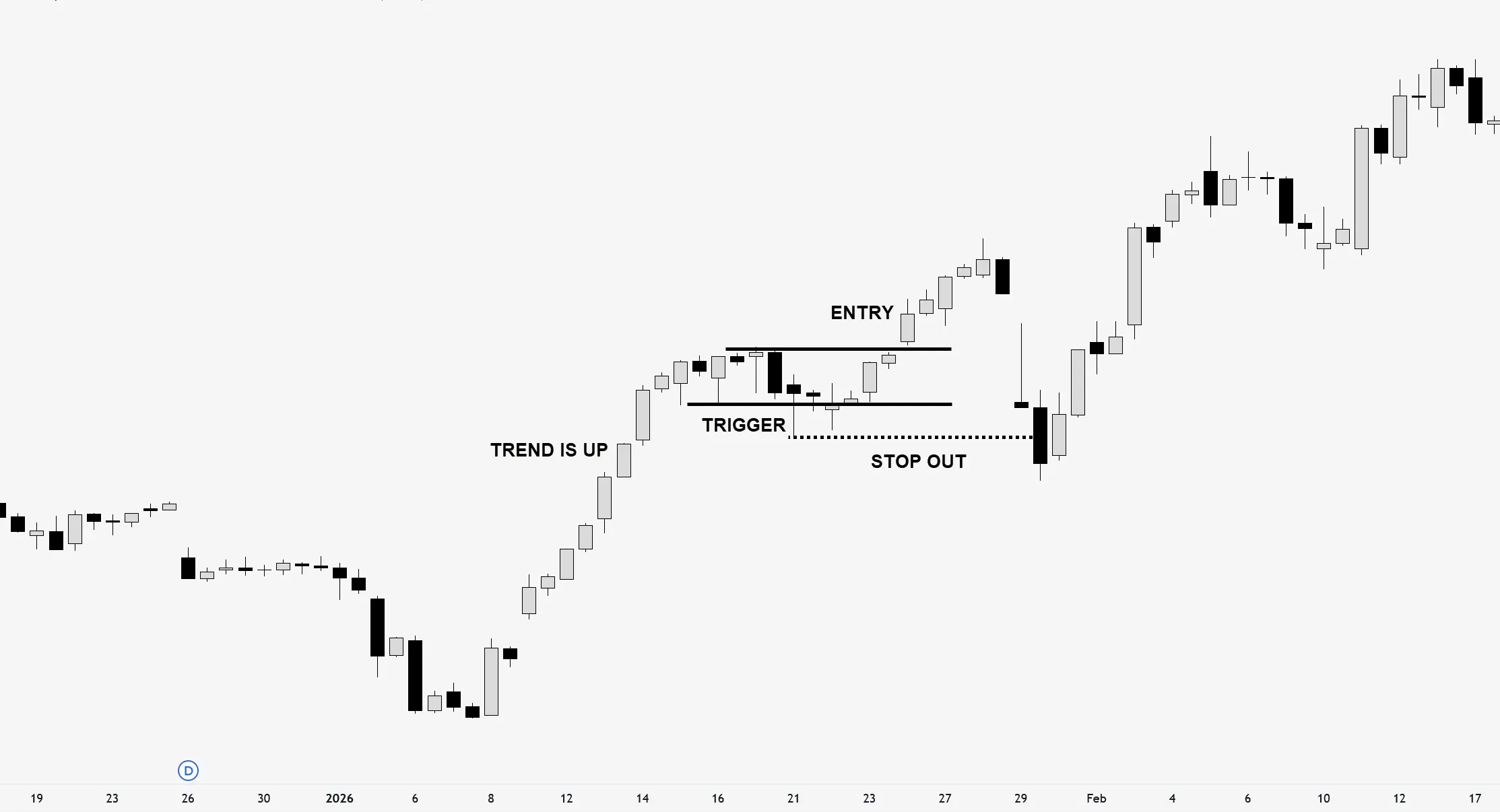
Why This Trade Still Earned a Strong Process Grade
The pullback setup qualified, the required trigger appeared, and the risk was defined before entry. Price later rejected at resistance and reversed into the stop. The outcome was a loss, but the decisions remained consistent with the plan.
When Does a Trading Mistake Become a Pattern?
One mistake is an event. Repeated mistakes under similar conditions form a pattern.
Do not rebuild your strategy because of one early entry or one poorly managed loss. Instead, track the category and context of each deviation.
Look for repetition:
- Are you entering early during fast markets?
- Are you widening stops after consecutive losses?
- Are you cutting trades early near the same type of resistance?
- Are most weak setups being taken late in the session?
- Are rule violations increasing after a large win or loss?
A pattern becomes meaningful when the same error appears often enough to suggest a repeatable trigger rather than an isolated lapse.
The number of trades required will depend on your strategy frequency and the issue being examined. There is no universal threshold that proves a pattern after three, ten, or fifty trades.
Use enough observations to separate recurring behavior from normal variation.
Most importantly, compare similar trades. Combining trend trades, range trades, different markets, and different time frames into one sample can hide the real problem.
What Should You Change After Reviewing the Trade?
The purpose of grading is not to produce a perfect journal.
It is to identify one useful change.
Start with the weakest process category.
If the setup grade keeps failing, tighten the qualification rules or stop taking trades that do not meet them.
If the entry grade is weak, define the trigger more precisely and document examples of valid and invalid entries.
If risk errors repeat, correct the position-sizing or stop-placement process before taking another trade.
If management is the problem, write down the exact conditions that permit a stop adjustment, partial exit, or early close.
Change one variable at a time.
If you alter the setup, entry, stop, target, and management rules together, you will not know which change affected the results.
Separate behavioral corrections from strategy changes:
- Behavioral correction: Follow an existing rule more consistently.
- Rule clarification: Rewrite a vague rule so it can be graded.
- Strategy change: Modify the actual logic of the method based on sufficient evidence.
Then track the new version across another comparable sample.
Review without action is record-keeping. Action without evidence is guesswork.
Conclusion
A trade is not good because it made money, and it is not bad simply because it lost.
Grade the decisions that were under your control:
- The market context
- The setup
- The entry
- The risk
- The management
- The quality of your records
Then record the outcome separately.
This process will not remove losses. It will show whether those losses came from normal strategy risk, poor execution, vague rules, or a problem that deserves deeper testing.
That is the real value of grading a trade. You stop asking only, “Did I make money?”
You start asking, “Did I make a decision worth repeating?”
