
- June 5, 2026
- Posted by: Shane Daly
- Categories: Trading Article, Trading Tutorials

You move your stop to breakeven to reduce risk, but doing it too early can create a false sense of control. You’re not eliminating risk if normal price movement can knock you out before the trade has proven itself. A disciplined adjustment needs more than a small unrealized gain. It needs evidence that the original risk has changed. The key is knowing what counts as evidence and what doesn’t.
Key Takeaways
- Move your stop to breakeven only after price reaches a predefined level that confirms reduced trade risk.
- Avoid moving stops early because normal pullbacks can trigger exits before the setup fully develops.
- Base breakeven adjustments on market structure, not discomfort, relief, or unrealized profit.
- Ensure the original invalidation point is no longer valid before changing the stop.
- Treat breakeven stops as capital protection, not a profit-locking strategy.
What Does Moving a Stop to Breakeven Mean?
A breakeven stop turns an open trade into a defined-risk position with little or no remaining downside on the original entry. You move your stop loss from its initial protective level to your entry price, or slightly beyond it to cover commissions, spread, or slippage.
If price reverses, the trade exits around flat instead of taking the planned initial loss. This adjustment doesn’t create profit (may just cover trade costs); it changes the trade’s risk profile after the market has moved in your favor.
In a breakeven strategy, you usually require objective evidence before going to breakeven: a measured price move, a closed candle beyond resistance, reduced volatility, or partial profit taken. You define that trigger before entry, so you manage risk by rule, not reaction, and keep execution consistent under pressure.
Why Breakeven Stops Feel Safer Than They Are
Moving your stop to breakeven can feel like disciplined risk control because you’ve removed the possibility of a full planned loss. But that comfort can really distort risk perception. You’re not eliminating uncertainty; you’re changing how you emotionally account for it.
- You feel protected because the trade can’t lose money.
- You may mistake relief for improved trade quality.
- You reduce anxiety, but you don’t reduce market noise.
- You anchor to entry, even if price structure matters more.
- You create emotional reactions that can override your plan.
Breakeven is psychologically powerful because it turns an open risk into a “free” trade in your mind.
Stay analytical. A zero-loss exit can still reflect poor stop placement, weak overall trading process, or avoidance of discomfort rather than disciplined management alone.
The Problem With Moving Your Stop Too Soon
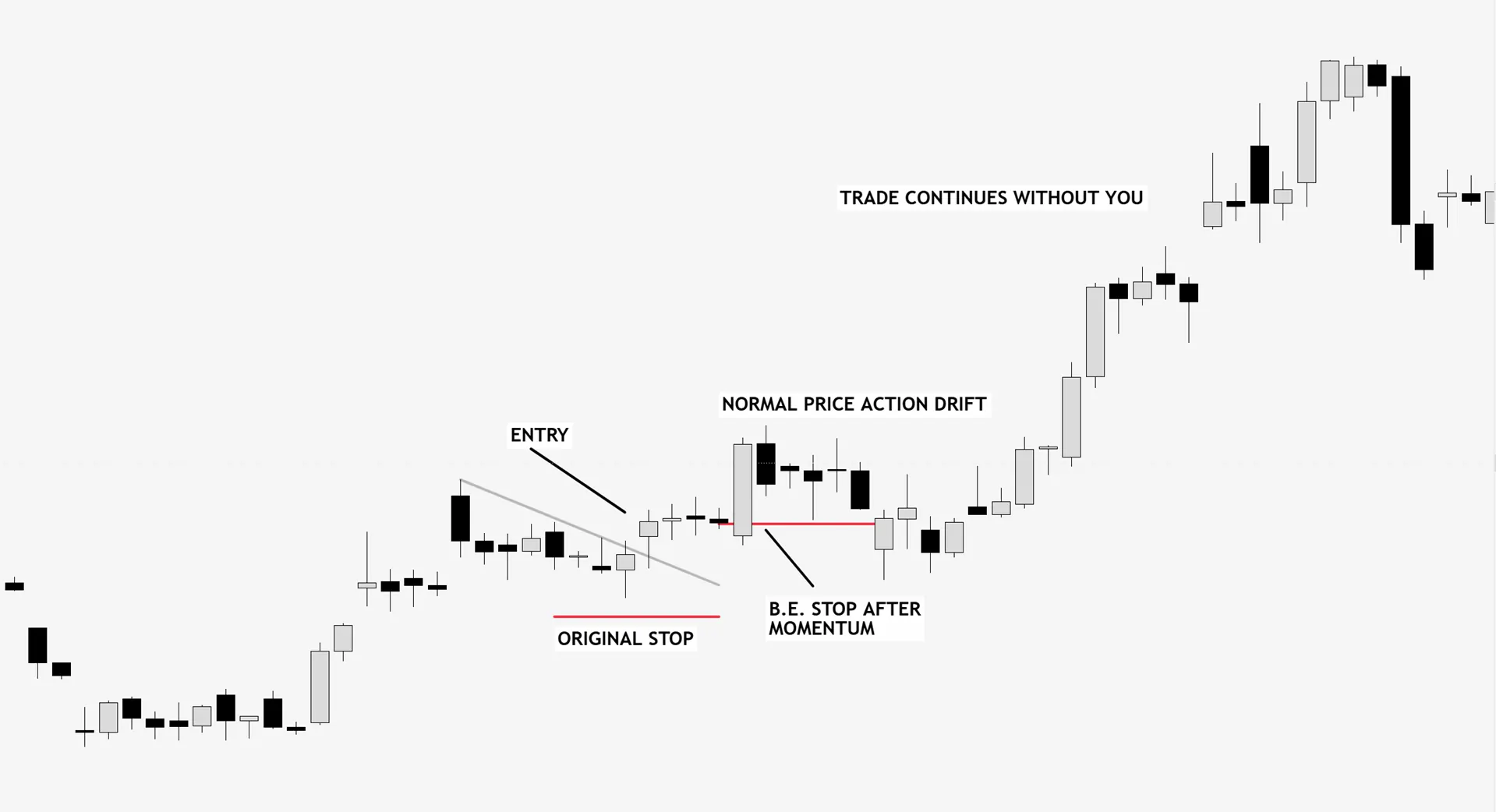
When you move your stop to breakeven too soon, you often replace planned risk with premature trade management. That shift can damage the trade’s structure.
Price rarely moves in a straight line, and normal pullbacks can tag your new stop before the setup has room to work. You don’t reduce risk; you change it. Instead of accepting the original invalidation point, you create a tighter exit based on discomfort.
Over time, this can turn entries into scratches, increase frustration, and distort your performance data. Worse, it rewards emotional decision making because a breakeven stop feels responsible, even when it conflicts with your risk management plan.
Your job isn’t to avoid every loss. Your job is to let valid risk play out while preventing downside.
When Should You Move Your Stop to Breakeven?
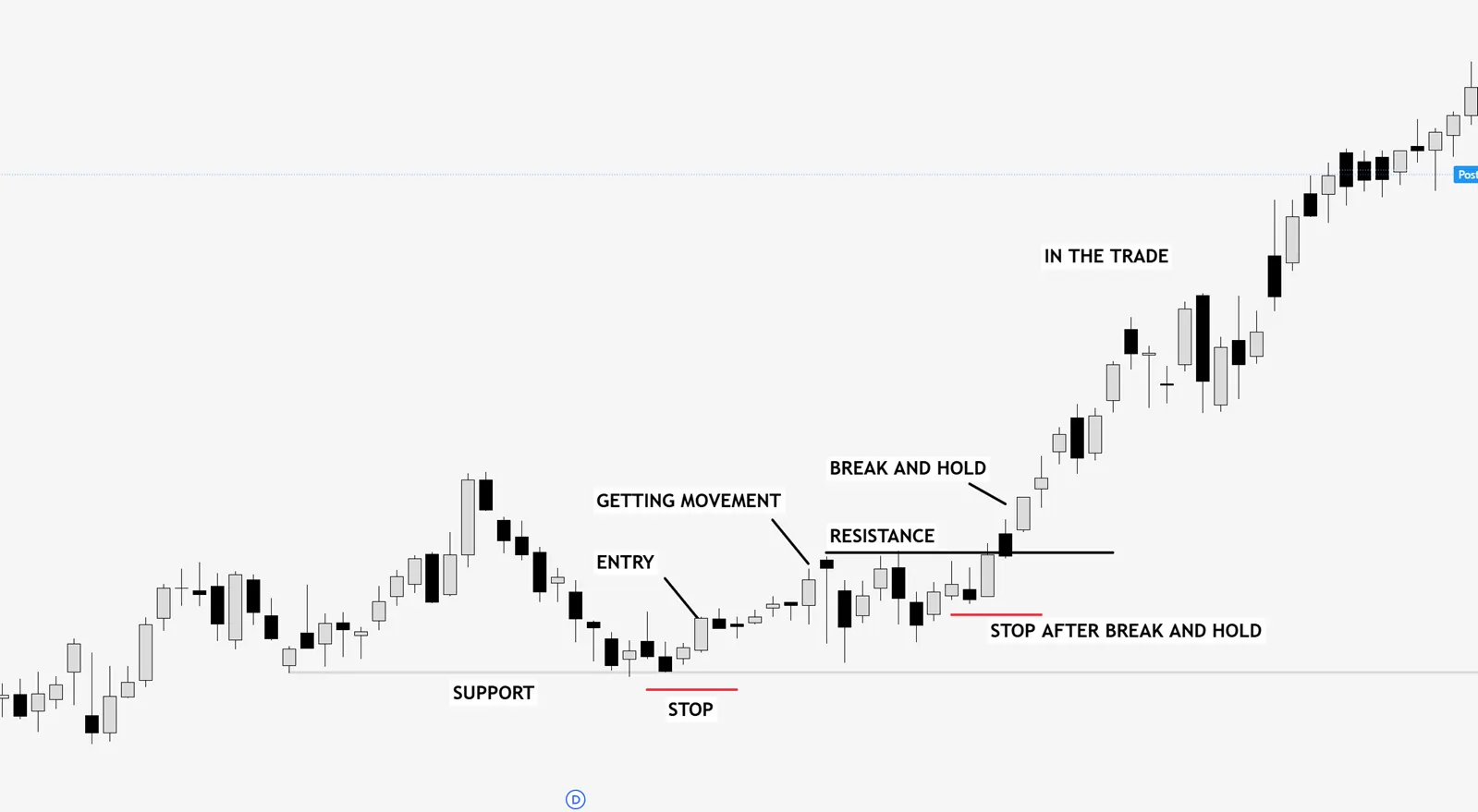
The right time to move your stop to breakeven is after the market has reduced the original trade risk, not after you’ve simply become uncomfortable.
You need confirmation that price action has shifted enough to make the remaining risk unnecessary, while your target still justifies staying involved.
- Let your exit strategy define the adjustment before entry, not during stress.
- Use risk management rules that protect capital without suffocating normal volatility.
- Move only when market structure supports lower exposure.
- Avoid reacting to a small unrealized gain.
- Accept that breakeven is a defensive tool, not a profit plan.
If you can’t explain why the initial stop is no longer needed, you’re not managing risk; you’re just trying to feel safe inside uncertainty.
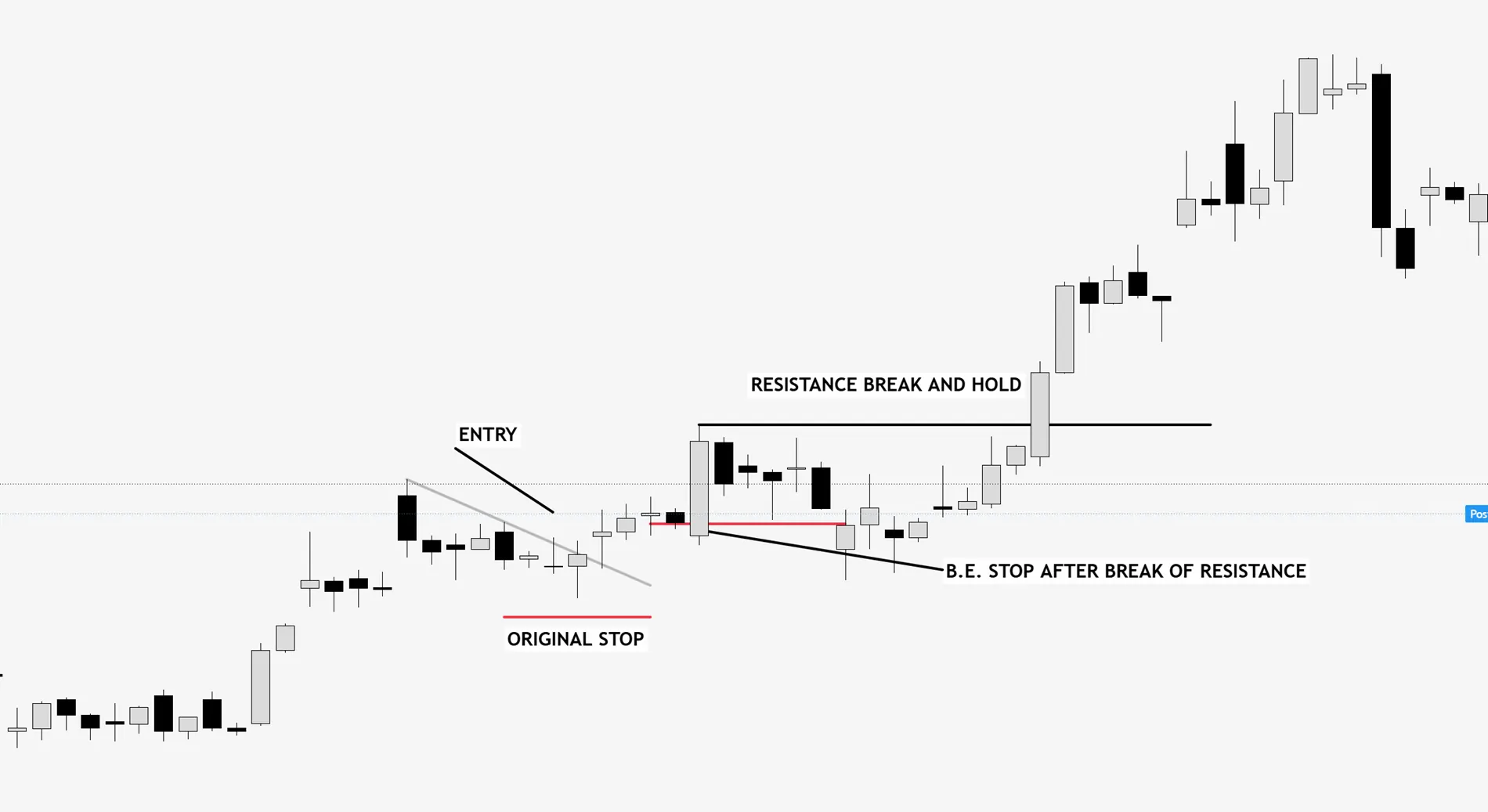
That weakens your discipline.
For example, if you enter long near support and price only moves slightly above entry, breakeven may still sit inside normal pullback noise. But if price breaks resistance, holds above it, and forms a higher low, the trade has created a new area where the stop can be reconsidered.
The 3-Part Breakeven Test
Before moving your stop to breakeven, the adjustment should pass all three tests. The goal is not to feel safer. The goal is to confirm that the trade has genuinely earned a lower-risk position.
Risk Reduction
Has the original risk actually changed?
Do not move the stop just because price moved slightly in your favor. The trade should have reduced meaningful downside risk, not simply created temporary relief.
Structural Confirmation
Has price created a new invalidation point?
Look for a higher low, lower high, breakout, retest, or other structural shift that makes the original stop location less relevant than it was at entry.
Reward Justification
Does the trade still have enough room to work?
If moving to breakeven places the stop inside normal pullback noise or damages the trade’s chance of reaching its target, the adjustment is probably too early.
A breakeven adjustment needs to pass three checks: risk reduction, structural confirmation, and reward justification.
First, ask whether moving the stop lowers meaningful risk, or only satisfies breakeven psychology. If price can still retest normal noise and your new stop sits inside that noise, you haven’t improved risk management; you’ve just increased stop-out probability.
Second, require structure. Let the market create a higher low, lower high, breakout, rejection, or volatility shift that proves your original risk point is no longer relevant. Don’t move because you feel exposed.
Third, check reward. If the tighter stop protects little capital but damages a high-quality target, wait. Your job isn’t to avoid every loss. It’s to reduce risk only when the trade’s evidence, structure, and payout still align.
Should You Move Your Stop to Breakeven After 1R?
After price reaches 1R, don’t treat breakeven as an automatic rule. You’ve earned distance, not certainty in the trade. Moving your stop loss too soon can remove valid trades before expectancy plays out. Use 1R as a review point, not a command.
- Check whether volatility still justifies the original risk.
- Ask if your target offers enough reward after friction.
- Confirm you’re not acting from fear of giving back gains.
- Compare the trade with your written risk management plan.
- Decide before entry how 1R affects your stop.
If your setup needs room, hold the planned stop. If risk has changed materially, reduce exposure or adjust with intent.
Your goal isn’t a free trade; it’s consistent execution under controlled risk over many trades without sabotaging your statistical edge today.
How Market Structure Can Help You Move a Stop Correctly
When price starts building structure in your favor, you can use that structure to manage risk instead of moving your stop blindly. Through market analysis, you watch whether new swing highs, higher lows, or reclaimed support levels confirm trend identification after your entry signals.
If the trade advances, don’t shift to breakeven just because you’ve reached a fixed profit multiple. First, run a volatility assessment and ask whether normal pullbacks still need room. Then place the stop beyond the latest meaningful structure, where the trade idea would weaken, not where your trade psychology feels less pressure.
This keeps risk management tied to evidence. Your position sizing should already define the maximum loss, so structural stop movement becomes a planned adjustment, not an emotional escape.
When Should You Not Move Your Stop to Breakeven?
If price hasn’t proven that your trade idea has gained structural support, don’t move your stop to breakeven just to remove discomfort.
Wait when risk has changed, not when anxiety spikes. Avoid breakeven moves when:
- Price remains inside the original noise range.
- No higher low, lower high, breakout, or rejection confirms your thesis.
- Volume, volatility, or momentum still contradicts your entry.
- The stop would sit at an obvious liquidity point.
- You’re reacting to unrealized profit, not objective evidence.
Premature adjustments can convert a valid trade into a needless scratch, then tempt you to re-enter worse.
Treat breakeven as a risk decision, not emotional decision making. If your invalidation level still makes sense, leave it.
Your job isn’t to feel safe; it’s to manage uncertainty.
Breakeven Stop vs Trailing Stop: What Is the Difference?
How do you know whether you’re protecting capital or managing profit? A breakeven stop moves your stop to your entry price, so the trade can’t become a loss before costs. It’s a defensive breakeven strategy: you remove original risk, but you don’t lock in gains.
Breakeven Stop vs. Trailing Stop
Both tools reduce risk, but they are not interchangeable. A breakeven stop protects capital after validation. A trailing stop manages open profit after the trade has moved further in your favor.
| Tool | Main Purpose | Best Used When | Main Risk |
|---|---|---|---|
| Breakeven Stop | Removes original downside risk | The trade has reduced initial risk through structure, confirmation, or a planned decision point. | Can stop you out too early if breakeven sits inside normal pullback noise. |
| Trailing Stop | Protects open profit | The trade has already moved meaningfully and you want to give it room while protecting part of the move. | Can trail too tightly and exit a valid continuation before the move has finished. |
A trailing stop does something different. It follows price as the trade moves in your favor, aiming to preserve open profit while allowing room for continuation. Use the distinction carefully. Moving to breakeven too soon can turn normal volatility into an exit. Trailing too tightly can do the same, only after profit appears.
Your risk management should define the purpose before the adjustment: breakeven protects capital; trailing manages earned edge. Confusing them leads to premature exits and distorted statistics.
A Simple Breakeven Stop Checklist Before You Adjust the Trade
Before you move a stop to breakeven, confirm you’re making a risk decision—not reacting to discomfort. Use a checklist so trading psychology doesn’t override your plan.
Before You Move the Stop, Confirm This
A breakeven stop should be based on evidence, not relief. Before you adjust the trade, make sure the move is supported by structure, risk, and the original plan.
- Price reached a predefined level, not just a small unrealized gain.
- Market structure has shifted, creating a stronger reason to reduce risk.
- The original invalidation point is less relevant than it was when you entered.
- Breakeven is not inside normal pullback noise, where a routine move could stop you out.
- The decision matches your plan, instead of reacting to fear, relief, or open profit.
If the stop adjustment fails any of these checks, wait. A breakeven move should be earned by evidence, not emotion.
Conclusion
Moving your stop to breakeven isn’t a reward for being right; it’s a risk decision. You should wait until price has reduced the original risk, confirmed structure, and given your setup room to work. If you move too early, you turn normal noise into an exit signal. Use your checklist, respect volatility, and let evidence—not fear—drive the adjustment. Protect capital, but don’t protect it so tightly that you sabotage the trade you planned for carefully.

